Always interesting, often different

Following my difficulties with Tesco, a couple of weeks later a friend of mine wrote on Facebook of her recent experience at her local ASDA and she has kindly said that I can reproduce her story, so here it is:

Breaking news:

ASDA – Old Kent Road, South London – assumes ANYONE with a ‘granny’ trolly (2 or 4 wheelers) is a shoplifter.

Store security guards have been instructed to stop and demand that ALL customers about to enter their store are required to leave their own ‘granny’ trollies at the entrance.

However, customers pushing buggies/prams & those driving mobility scooters – with or without storage facilities – are free to enter unchallenged (obviously low income parents of young children and the mobility restricted are all salt of the earth honest people, unlike them there OAPs out for a bit of grab & dash!)

When asked why this policy had been introduce, the “People Service Manage” at ASDA explained that “using a granny trolley was the 2nd most used method of shoplifting” (the 1st being Self Checkout Tills)

So, if you know of any lil’ ol’ ladies wanting to do a bit of shopping, tell ’em to go to Tesco cos ASDA’s on to their thieving li’le game!!

After all, Every Little Helps ; )

Another case of discriminating against disabled people!

My friend, who is also disabled needs to use a trolley for shopping as she cant carry heavy items. To suggest that she, and others who need to use these trollies are less than honest is quite disgraceful!

Come on ASDA – please re-think this daft and insulting policy.

When I posted my ‘Why the Difference?’ blog it was also sent as a link to my Twitter account.

I soon got a lovely thank-you from M&S, closely followed by message from Tesco asking which store I had used, and subsequently inviting me to contact the store manager when I’m next in store.

I will be doing this, and blogging what happens. But I’ve not yet ventured out shopping this year, the weather has put me off going anywhere and I’ve got a Tesco delivery coming later this week, so if that is missing any items I’ve ordered, a not uncommon occurrence, I will be forced to go out to Tesco.

So, watch this space………… update coming soon.

This week I’ve had two very different shopping experiences in two major store chains.

Food shopping is never my favourite job, I order on-line as much as possible and I try to avoid busy and crowed times. Usually my shopping helper is my neighbour’s teenage daughter, she has Aspergers, and is a good helper, her traits mean that she knows my routine and remembers it. So shopping without her isn’t easy, but her Mum is ill and needs her daughter at home right now.

So, off to Tesco’s on my own for a quick shop for perishables. I use a local big store, which does have one motorised buggy with a large basket, but even if I use it I still can’t reach items on low or high shelves, so I still need a helper. Also, even if I can park near enough to stagger to customer services to collect the buggy, it has to be fetched from another part of the store, which can take up to 10 minutes, I can’t stand for that that long and there is not seating available. The buggy used to be kept by customer service, and I could sit in it it whilst the key was found. For some reason I could never fathom the key was kept somewhere other than the customer service desk! When the buggy was moved I did email the manager, explaining that the new arrangements would make it difficult for both myself and other disabled people, but got no reply. That was a foretaste of my shopping experience.

When I got to the customer service and asked for an assistant to help me shop, the first response I got was; “Why can’t you just use the trolley that attaches to a wheelchair?” When I explained that it only worked for manual wheelchairs (which I knew from trying previously) I was greeted with a blank stare. So, I asked for the assistant again, and with a big sigh, the woman on the desk sent a Tannoy message out, I was glad I was sitting in my wheelchair as it took over 10 minutes for someone to come, and then the man who arrived looked at me, spoke to the woman on customer service, and walked off, without explanation! A few minutes later he came back, and grunted he was ready to help.

My assistant was a man in his late twenties, whose first language was not English, and whilst I’m used to employing people from many different ethnic backgrounds, having managed nursing homes for over 20 years, I reckon my communications skills are pretty ok, but the guy helping me seemed to not understand me at all. Whatever I said I needed, he didn’t seem to know what it was, at the sandwich counter he didn’t know what a wrap was, and at the sushi bar picked out salmon when I asked for prawn, similarly he didn’t seem to know what Brie cheese was. For other items, he didn’t know where they were in the shop or was similarly puzzled as to what they were. Also, when he took something off the shelf, he didn’t check with me if it was the right item, so I had to constantly ask to check he had picked what I needed.

I was very glad when we got to checkout, where he packed everything well. On the way to the car I asked the man what training he was given, but he didn’t answer, just shrugging his shoulders. I don’t think I was an usual customer in terms of my shopping, I had a list, stuck to it and was as systematic as possible. But somehow nothing was quite as it should be. I felt as if I had been an inconvenience, that my helper would rather have been doing something else, anything other than working and assisting a customer.

Just a week later, 5 days before Xmas, I did my final shop, this time at Marks & Spencer at Kew retail park. My treat for holiday. What a different experience. Although customer service was busy, another assistant came up to me and asked if I needed help, no sooner has she left to go and find someone, another assistant came up to me and asked if I needed assistance. Just as she was speaking to me the first assistant came back and introduced me to my helper. She was probably in her late thirties, English was not her first language, but she understood exactly what I was saying.

The shop was really busy, but nothing was too much trouble, she checked exactly what I needed and found it, often suggesting I wait at the end of an isle so I didn’t need to struggle to get through the crowds. She doubled checked with me that everything was what I needed and even suggested other things I might like to try. There were two things that seemed to be out of stock, one of which was my favourite cherry juice. So, my helper went to the stock room to try and find them, but thoughtfully put an alternative, which was running low in my trolley to ensure I got a fruit juice I liked. The cherry juice soon arrived and we were off to checkout. Again, nothing was to much trouble, I was asked how I wanted everything packed and she made sure no bag was too heavy. There was no need to ask about customer service training, I couldn’t have had more assistance if my helper had seen one of those posh personal shoppers you see on TV at Liberty. I tried to give her a tip, but she wouldn’t accept it, saying it wasn’t allowed. So this is one way I can thank her for her excellent customer service.

Why was there such a difference in the two shops? Was it training, or the lack of it, was it attitude, or just gender, the woman being the more attuned to another woman’s needs. Was it that unsaid word ‘class’?

Well, for what it’s worth, I think it’s a combination of all of those things. As in any organisation, attitudes permeate from the top downwards. I’ve shopped at both Tesco and M&S for years. Even when I was able bodied I was well aware that each of those shops treated customers very differently and that difference is stronger and starker when a customer needs a little extra help to do any everyday task.

I wish I could afford to shop at M&S every time, but DLA does stretch to that, it’s definitely a treat and I cannot buy everything I need there, So I’m forced to shop at Tesco or Sainsbury, but a trip to my nearest Sainsbury about a month ago did not inspire confidence. There is no other large supermarket within reasonable travelling distance.

So I’m running out of options, I have to accept what is begrudging and what, in different circumstances I would not. Just because I can’t be totally independent. If I were back at work, and something similar had happened to a client I would be the first one trying to sort things out. Calling the shop manager, trying to explain how staff should have behaved differently. But, for me, there are more important battles to fight, more urgent things to do, which take up my emotional and physical energy.

Maybe Morrison’s will open a new supermarket in west London, but until then, I’m going to be putting off doing food shopping as much as possible.

Today, Jane Nicklinson the widow of Tony Nicklinson, the right to die campaigner was at the Supreme Court in London, to ask the judges to give guidance on whether it is permissible for a doctor to assist a severely disabled person to die, when it is that person’s wish.

Tony was severely disabled, totally dependant on others for all his care. He wanted the right to die, at a time of his own choosing. Because he was unable to commit suicide unaided he wanted to a doctor to help him die, and to ensure the doctor would not subsequently be prosecuted for murder, as currently the case in the UK.

This case is particularly unusual, because Tony died earlier this year on 22 August. Jane was given special permission by the courts to continue with Tony’s battle. Just 6 days before Tony died the High Court in London turned down his request to allow a doctor to help him die, but most unusually, gave immediate permission for him to appeal to the Supreme Court.

For Jane to continue fighting on Tony’s behalf, is not only a wonderful tribute to Tony, but unique in UK legal history. Normally, if someone dies their legal fight dies with them. Such is the importance of this case, that it can proceed even though Tony is no longer alive.

Jane is joined by Paul Lamb, another very disabled man who is making the same request as Tony did and was involved in the original High Court Case.

There was another person at the Supreme Court this morning. He case is similar, but differs slightly. Martin (whose surname is not disclosed) had a massive stoke in 2008. Martin wants to be able to take his own life at a suicide facility in Switzerland. He describes his current situation as “undignified, distressing and intolerable”.

Martin’s wife and other family members are unwilling to help him, so he wants to ensure that any medical or nursing professional who goes with him is not prosecuted, as could be the case at present. At the moment such decisions are made on a case by case basis. Although the current legal guidance is that prosecution is unlikely, Martin seeks greater reassurance and clearer guidance.

I am pleased that it has been reported on the BBC news website, that the DPP (Director of Public Prosecutions) will have to draw up new guidelines. This is a decision I feel sure the Supreme Court Judges have been right and wise in making.

The whole debate about right to die raises strong feelings, especially amongst people with disabilities. Some disabled people feel that allowing severely disabled people to have the right to self-determination when it comes to how they die could lead to them being pressured by others. They see allowing such decisions as the slippery slope towards the eugenics of the Hitler’s Nazi Regime.

As someone who is disabled, but has also been a Registered Nurse for over 30 years, I take a different view. I have seen too much suffering. I saw my mother dying from cancer, only being free of pain when she was unconscious for the last week of her life. She was several years younger than I am now. During my career I specialised in nursing people with terminal illnesses and also those with severe physically disabilities. No matter how much good nursing care we could give or how skilled the medical interventions, I saw too many people who felt their quality of life was so poor that they wanted help to die. I also saw greater number of others who had a good, pain free death.

About 25 years ago I joined what was then called The Voluntary Euthanasia Society and is now Dignity in Dying. I feel strongly that everyone, no matter how disabled, has the right to self-determination in the way that they die. That should not be compromised by the inability of physical actuality.

My children know that I have made an Advanced Directive. Should I ever have a massive stroke, or have major brain damage, I do not want to be kept alive. I don’t want artificial feeding or hydration or kept on a ventilator.

In my life I have enjoyed many good things and met wonderful people. I want my children and grandchildren to know that it is the quality of life that matters, not its quantity.

So my plea to the Supreme Court Judges is very simple; please let those of us who are unfortunate enough to be unable to control our own destinies have the reassurance that those who help us have a good death are not punished for their courageous deeds. Please give us dignity in the way we chose to die.

I’ve just finished watching the funeral for Nelson Mandela. I’ve followed all the coverage closely over the last 10 days. South Africa is country dear to my heart, not only because of my involvement in the Anti-Apartheid movement, but because my adopted daughter, a Zulu, was born there.

Mandiba was a remarkable man, who with others transformed his country and gave it one of the most non-discriminatory constitutions in the world. So, in that wonderful rainbow nation where were the disabled people? As I watched the crowds in Pretoria outside Mandiba’s home, the thousands at the football stadium, the hundreds queuing to view his body and those who lined the route his coffin travelled to Qunu yesterday, I did not see one physically disabled person.

I asked my daughter, who is currently in South Africa with her sons, if she has seen disabled people on any of the local footage. She told me she’d only seen one person who was in the queue at Mandiba’s lying in state.

Because I was uncertain about writing this particular blog, I also sought advice from my daughter, a woman wise beyond her years. She told me the facilities in South Africa for disabled people are not good, that disabled people are not as respected as they should be. That the authorities think that just because they provide a couple of disabled parking bays, an extra accessible loo and some ramps they have done enough.

It seems as if not everyone is equal, despite the constitution (and I’m not just talking about the huge inequalities of wealth and opportunity that still exist). For disabled people, South Africa is rather like the UK was before the DDA was made law. I’m sure that they would be many experienced disabled people in the UK who would willingly give help and advice to the South African government and other powerful organisations to help disabled South Africans play a greater role in their country.

I would be honoured to be part of that.

The jailing for 5 years of Alan Watts on Thursday this week for the murder of Brian Holmes, because he wrongly believed that Mr Holmes should not have been parking in a Blue Badge Bay in the ASDA car park in Biggleswade, Bedfordshire, has caused me to ponder once again about how disabled people are treated.

In the case I’ve cited, Alan Homes who had recently recovered from cancer, was not the Blue Badge holder, but his wife who was disabled and shopping in the ASDA store was entitled to use the bay. So, on a wrong hasty premise, violence occurred and a much-loved man lost his life in a cruel, premature and dreadful way.

His murderer Watts was another pensioner, and in none of the reports that I have read was there any mention him being physically disabled. So I’m presuming that Watts himself was not entitled to use a Blue Badge, and was probably just judging and interfering in something that was actually nothing to do with him at all.

Why is it that some people chose to set themselves up as ‘moral police’ and think they know better than others?

Why do they think they have this right?

Is it because Ian Duncan-Smith and other Tories seek to demonise disabled people and threaten even the most disabled and the dying with loss of benefits?

One of the things that being disabled has taught me is that Is that often disabilities are hidden. One of my disabilities is not visible unless I try to walk any distance, I only have 40% lung function and that obviously greatly affects what I can do.

When I first started to need to use an electric buggy for mobilisation I was in my early 50s and I used to get very suspicious looks from people, some even suggested that I didn’t need to use it at all. If I felt brave enough I would explain why I needed to do so. Sometimes I just said “You’re lucky you don’t have my disability”, other times I just ignored the comments.

I sometimes get the impression some that non-disabled people do not think that we (as disabled people) should have any ‘preferential’ treatment.

Believe me, believing disabled is not ‘the easy option’. I, and many disabled people I know, would love to be well enough to work full-time, to be able to go shopping and not have to spend the rest of the day resting to get pain levels and breathlessness stable again. It would be lovely to be spontaneous again and not have to plan everything around how or where to park and when I’ve got someone to go with me.

I wish I didn’t need to use Blue Badge Bays, or a wheelchair, but I can’t change the fact of how that aspect of my life is governed.

Blue Badge Bays are NOT a privilege, they are a much-needed help for those of us that need to use them.

One of the organisations I belong to Disabled Motoring UK runs an annual survey called BayWatch. This asks members to monitor Blue Badge Bays in their local supermarket and check how many are being used by cars not displaying a Blue Badge and how the supermarkets deal with these infringements. As supermarket car parks are private land mis-use of bays is not a matter for Local Authority Parking Wardens. I’ve never joined in this survey as I’ve not felt brave enough to do so. I have always been concerned about encountering someone who would be abusive or threatening.

I once read about a disabled woman who printed out a sign which said ‘You’ve parked in my parking space, would you like my disability too?’ She used to place this on cars in her local supermarket who were parked in Blue Badge Bays without displaying a badge. I wish I could reach car windscreens from my wheelchair to do the same!

But, back to my original questions. Is our society just becoming more intolerant and/or violent? Should we as disabled people be more vocal when we are challenged or is silence the safe option? I don’t know the answer, but I know that statistics say that violent crime is decreasing, however I’m not sure I believe the statistics!

I do know that as a woman on my own, I’m not brave enough to challenge others, even though I would like to. I’ve been political all my life, being involved with CND, the Anti-Apartheid Campaign, Amnesty International and many others, but now my campaigning has to be through this blog and the occasional tweet or letter to a newspaper.

Disabled people deserve the same rights and considerations as any other human beings. We don’t need sympathy, just understanding and some help to do those things which non-disabled people take for granted.

It is a mitzvah (commandment) in Jewish teaching that we should not judge others harshly. In the Christian faith there is a saying by Jesus “Judge not least you be judged”. My grandmother taught me “If you can’t say anything good about someone keep quiet!”

If more people followed even one of these dictums the world would be a better place and disabled people would be treated with less suspicion and more courtesy.

One of the daily difficulties I have is the need to hold my iPad in my left hand whilst I’m either typing or web surfing. Also my grip in that hand is poor so sometimes my precious iPad has been dropped. I also get quite bad pain in my left wrist, and have cortisone injections as a result. So I’ve been looking out for a stand that would hold my iPad, I use it to do so many things and if I don’t have to hold it all the time it would be some much easier to multi-task.

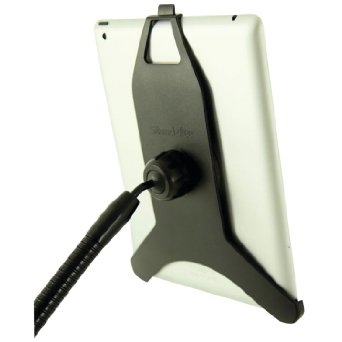
Thanks to Amazon, (as a disabled person I don’t know how I would manage without them, so much easier and cheaper to buy on line, than having to struggle to get to shops) I found a product called a Standzfree. It has a thin base that easily goes under my bed or sofa and then a height-adjustable pole, with a flexible arm at the end of which is a ball & socket joint with a manoeuvrable tri-shaped holder for the iPad, enabling it to be moved into the optimum position for use.

My only minor niggle is that the single clip that helps to keep the iPad in place clips into the slot used for charging the iPad. This means the iPad is slightly less stable in the stand if used whilst on charge. So apart from it’s overnight change for cloud back-up I try only to charge the iPad when watching a streamed film or broadcast, when stability is less of an issue.

It was well worth the money, for £61 including delivery I now have the ability to write this blog whilst laying comfortably in bed! Reduced pain and luxury!

Standzfree have a US site for anyone not wanting to use Amazon

They also have a twitter feed & a Facebook page

The images below are from the Standzfree page on Amazon.co.uk

20130924-132920.jpg

20130924-132955.jpg

Visual Update

No, this is not a software update as so many of us have been doing on our iPhones & iPads, but continuing the tale of my vision following my partial corneal transplant. Sadly, and somewhat infuriatingly, I’m still not able to wear my new lens for longer than about 4 hours. This greatly restricts what I can do in a day, I have to decide if I wear my lens for dealing with the pile of snail mail that comes through my letter box or have the luxury of being able to see some television of an evening. On a day when I have a hospital appointment, my wearing time is used to give me in the independence to drive myself.

My experiences of using hospital transport which can take 8 hours to get me to and fro a half hour appointment, causing me to miss meals and care visits, and on one occasion damage to my wheelchair, has meant that if I can drive myself I will. On my visit back to Ken Pullum at Moorfields Eye Hospital when I explained about the discomfort I was having Ken re-examined my eye and felt the discomfort was caused because the lens was not fitting snugly enough (due to the steepness of my eye profile caused by keratoconus) and I was loosing much of the fluid which I have to fill the lens with before insertion. Ken therefore decided that I needed to be fitted with a custom made lens. This is made by opening my eyelids very wide and putting an eye shaped cup attached to a hollow tube in my eye and injecting a blue goo-like substance into the tube until it fills the cup and makes an impression of the surface of my eye. It didn’t hurt, but was just rather uncomfortable for a time. However the equipment did remind me of the kit I’ve used to fill holes in walls before painting!

I returned to Moorfields last week for a fitting. The new lens is quite a different shape from my ‘off the shelf’ lens and looked somewhat bigger. I was worried about how I would tolerate it, but managed keep the new lens in for about two hours with very little discomfort. Ken was happy with the fit so the next stage was refraction. This is needed to ensure I would have good enough vision to be able to drive. I have decided that I want to be able to use it for distance ie driving and watching TV. At the moment I’m having to wear glasses on top of my lenses to be able to drive. As I spend quite a bit of my time using my iPad when watching/listening to TV I’m finding that having to peer over my glasses to see TV properly doesn’t really work and that I’d rather have half moon reading glasses. Also because my eyes are very sensitive to sunlight on sunny days when I’m driving or outdoors I have to wear over-glasses to reduce the glare. These are rather cumbersome and don’t fit easily over my distance glasses. It will be rather good to be able to wear fashion sunglasses after so many years!

So I now have wait several weeks to get my lens back, then hopefully more freedom.

For the last 3 months I have been unable to drive my Motability car. One Wednesday in March I began to have some very blurred vision in my left eye. Having had a corneal graft in that eye 20 years ago for Keratoconus I went straight back to my optician who told me to go to Moorfields Eye Hospital casualty immediately.

That proved easier said than done, as I had to get my GP surgery to organise transport, because I could not see well enough to drive. The receptionist I first spoke to said she could not do this and it was only when I spoke to my excellent GP and the practice manager that everything got sorted out. The ambulance arrived quickly, and then I hit another snag, they couldn’t fit my wheelchair into the ambulance without folding it up. That meant taking out the batteries, which the paramedics were not supposed to do. Eventually they did agree and I was soon on my way across London, feeling very scared and anxious.

On arrival at Moorfields I was seen very swiftly by the triage nurse, and soon after was taken through to see the doctor. After examining my eye thoroughly and taking a full history from me he said I would need to come back in two days time to see a Consultant. Eventually transport was sorted out to take me home and to come back again on the Friday. The kind nursing staff even found me a bed to lay down on whilst I was waiting. I eventually got home at 2am! I was tired, exhausted and in a lot of pain. Sitting in a wheelchair for over 6 hours doesn’t help with back and neck pain!

Now I had lost my independence. I could not see well enough out of my right eye to drive. I was reliant on help from carers and friends. The only time I could leave my flat was for hospital visits.

When I went back to Moorfields I saw a wonderful consultant, Mr Bruce Allan MD FRCS who explained that the corneal graft I had 20 years ago had partially rejected and my eye was leaking fluid. I was prescribed steroid eye drops and antibiotic eye drops to take and an appointment was made for the following week for me to return.

After two more visits it was decided that the drops weren’t working sufficiently and my graft was still at risk so I would need surgery. I was half prepared for this, but was surprised to discover that I would be unable to have my op at Moorfields as they no longer do general anaesthetics there, only day surgery under local anaesthetic. Unfortunately I am severely allergic to local anaesthetics so that was not an option for me

I was to be transferred to another consultant Mr Romesh Angunawela BM, MD, FRCOphth, FRCSEd, who proved to be as superb as his colleague. He operates at a South London hospital where It would be possible for me to stay overnight. This was all arranged quickly and professionally, with the consultant himself phoning me to explain what would be happening. I was much reassured by that, even though I wasn’t looking forward to going into hospital.

My operation was going to to be a complex one, but I had very good and thorough pre-op assessments by both the nurse on the ward and the Consultant Anaesthetist.

My stay was rather mixed, I had excellent medical care and the surgery went well, but my nursing care left a great deal to be desired! A topic for a separate blog.

Once home it was a case of regular eye drops and being patient. Not easy for me, who is always keen to be out going to a gallery or exhibition or off to visit friends. I also regularly see my cousin in North London to whom I’m very close. Despite being from different generations, we share many views and attitudes and have some surprisingly similar life experiences. She also now relies on me for emotional support and I love talking with her and helping to make her life better. From seeing her at least once and sometimes twice a week to only having phone contact has been hard for both of us.

After 8 weeks of hospital visits I was beginning to struggle with not being able to do the things I take for granted. My iPad and iPhone have become even more important to me but what I missed most was the freedom of being able to drive. It was hard to find people who I could put on my car insurance. Motability has a rule that secondary drivers must live within 12 miles of me to be eligible. As most of my London friends don’t drive, this was a real problem, as anyone outside that limit could only drive for 30 days.

I had one person who was willing to drive for me, but I would need to cover her travel expenses and pay for her time, I was happy to do this, but Social Services made it clear that they would not automatically increase my care hours to cover this. I was also warned that if I did ask for my hours to be re-assessed I was in danger of them being reduced not increased. With my current care hours being insufficient for my needs this was a risk I was unwilling to take. So I lost the services of that person as she could not afford to work for me for free. I really understood, she had financial commitments that meant she had to earn money, I just wished I could have had even temporary extra hours to employ her.

Explaining this to my consultant one Friday afternoon he suggested that I be fitted with scleral contact lenses. These would help to promote healing in my eye, as this had been slower than expected, and give me enough vision to be able to drive.

I’d never heard of these lenses, and once home, avidly searched the net for information. I saw one of the contact lenses fitters that same afternoon, and as they had difficulty getting the right lens to fit me, I was asked to come back the following Monday to been seen by Mr Ken Pullum BSc FCOptom DCLP, a highly experienced fitter specialising in scleral lenses.
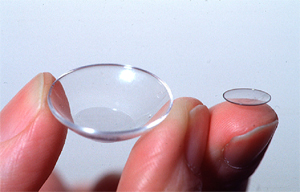
Scleral contact lens

A scleral contact lens with the smaller corneal lens to show size comparison

Ken could not have been kinder more patient or more helpful. After trying many different lenses he eventually found one that was a perfect fit and once he added the extra lens power, managed to give me excellent vision. Now it was a case of waiting for then to be made.

Some three weeks later I was back in the clinic, yes they were a great fit, but the vision wasn’t quite right. But, it was possible to adjust the visual acuity of the lens, how I’m not sure, so another weeks wait. So near and yet so far…………

Back again, the lenses was better, but my vision not as sharp as I needed it to be for distance, great for reading or computer though. So Ken came up with the idea of getting the spectacles department to make up a pair of glasses to wear on top of my lenses.

I so hoped that would not take long. And indeed it didn’t, a hour later I had my glasses. With my son-in-law by my side (he had kindly got up before 6am and travelled across town to drive me to my appointment) I set off to drive to my cousin who was eagerly awaiting my visit.

It was so good to drive again! Unlike many people, I quite enjoy driving through London, I’ve done so for years because of work, and am used to negotiating the busy traffic and sometimes crazy cyclists. My biggest fear is hitting one of them. I really think they should either have to pass a test, like the rest of us or be licensed. I don’t think London roads are designed to be able to sensibly separate cycles and other road users.

My lenses are taking time to get used to and I can only wear them for a few hours before they get cloudy and need to be cleaned. Not uncommon from info on the net. I also discovered that I was allergic to one of the saline liquids needed to put in the lenses before insertion to keep the eye moist. It contained a preservative, and that meant I needed to use a another solution, but thankfully I had been given a different one, Quattro, which seems to work well.

Yesterday it was great to be able to drive myself to get a much needed hair cut and some basic shopping, Not a big deal for most people, but it has meant the beginning of freedom again for me.

I am profoundly grateful for the professional skills and expertise of Mr Bruce Allan and Mr Romesh Angunawela, also the knowledge and kindness of Mr Ken Pullum. You have all contributed to giving me my independence and my life back.

All I need to do now is slowly increase my wearing time to get several consecutive hours wear from my lenses so I can get out and about for longer.

Asking the obvious

I was recently referred back to Charing Cross Hospital to the Rheumatology department for a steroid injection in my left wrist, I’ve been there before and had excellent care from a lovely Consultant who has sadly left.

I was seen by a Registrar who I’d not met before, and for some reason my full notes were not available. So, I gave him a potted medical history; severe spinal arthritis, scoliosis of the spine, displaced vertebrae in my neck, only 50% use of my left arm and 40% Lung function – not smoking related. I showed him a list of my medication, which includes morphine patches for pain relief.

He then asked why I was using a wheelchair………………!!

Which left me rather speechless. I‘m not usually lost for words, but said something like; “Severe arthritis, on morphine, get very breathless, is that enough?”

I got a sort of grunt in reply.

Afterwards I felt really shocked.  Was it too much to except that a senior Doctor would realise why I was using a wheelchair, without needing to ask?

Are my expectations too high?

Or is the NHS not recruiting Doctors of a high enough caliber?

Tag Cloud