How (not) to chose a carer – Part 1
Finding the right carer can be like crossing a minefield
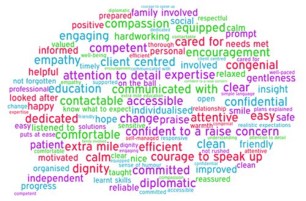
I have needed carers to help me for over 10 years now and these are some of the things I’ve learnt.
If you chose to use an Agency you will be able to meet with a number of different companies to see which one is able to best meet your needs.
However, if your care is organised by Social Workers, you or you family will have little choice as to which Agency provides your care needs as this is decided for you by your LA (Local Authority). But most importantly, you do still have a choice over who comes into your home.
If you find a carer disrespectful or rude or they do not understand your needs or provide poor care, you have a right to refuse to have that carer back again.
Because care work is so poorly paid a high percentage of agency carers are from outside the UK. My experience is that many do not either speak or understand sufficient English to be able to meet my needs. And if I’m struggling to work with them, heaven help anyone who is deaf or has impaired vision or speech!
I have spent almost all of my working life employing Nurses and carers from ethnically diverse backgrounds – so I’m well used to making sure care staff can be easily understood by their colleagues and the residents they care for. Also I often had a good number of applicants for each job. However Agencies today are usually so pressured to provide a service that they take on staff whose English is not as good as it should be.
Carers are in our homes for a short fixed time only and they always seem to be rushing to get to their next client. An Agency I used recently sent me a carer who was good – but every time she got delayed at a previous client’s house she missed my visit – leaving me with no breakfast and unable to take the pills I need to have with food. My pain levels increased dramatically, impacting on the rest of my day. After 3 mornings of this – I had no alternative but to ask the agency not to send me that carer again and made the decision to go back to directly employing someone.
The example I’ve just used is fairly extreme, but often it’s been really simple things that carers have struggled with – not burning food – making sure food is cooked properly & served on a hot plate or bowl. Making sure I have the right cutlery. Washing up is a very basic task, but yet I’ve often found that I’ve need to check that dishes and cutlery are washed properly.
I’ve had carers who have refused to do any domestic work, ie cleaning or hoovering, even if that has been part of the work they are contracted to do. I’ve had a carer pull a Dyson so roughly that she has broken the hose – and then denied she had done so – the agency refused to take responsibility for the damage, and whilst I was still arguing with their insurers – the agency lost the contact with the borough I lived in and went bust – so I ended up very out of pocket.
For a time one London Borough where I lived paid a company to undertake shopping at Tesco’s for clients. For the 3 months I used them I don’t think I ever got the right order! One day when my flat front door and step were being painted the delivery guy walked onto the step and left a large black boot print on my carpet and slammed my front door so hard he made a hole in the wall of my hall! As soon as I realised I called the agency & the Council – the agency were less than helpful and I only got a very small settlement.
There are good agency carers, but I no know it can take time for me to find the carer who can best meet my needs. I have used 6 or 7 agencies so far and only one sent me a great carer from the outset, with others I went though at between 5 or 8 people to get someone who was able to care for me properly.
This is the first of two blog posts on this topic.
Part 2 will follow shortly.


 Life from my Wheelchair
A Plea to the Supreme Court
Today, Jane Nicklinson the widow of Tony Nicklinson, the right to die campaigner was at the Supreme Court in London, to ask the judges to give guidance on whether it is permissible for a doctor to assist a severely disabled person to die, when it is that person’s wish.
Tony was severely disabled, totally dependant on others for all his care. He wanted the right to die, at a time of his own choosing. Because he was unable to commit suicide unaided he wanted to a doctor to help him die, and to ensure the doctor would not subsequently be prosecuted for murder, as currently the case in the UK.
This case is particularly unusual, because Tony died earlier this year on 22 August. Jane was given special permission by the courts to continue with Tony’s battle. Just 6 days before Tony died the High Court in London turned down his request to allow a doctor to help him die, but most unusually, gave immediate permission for him to appeal to the Supreme Court.
For Jane to continue fighting on Tony’s behalf, is not only a wonderful tribute to Tony, but unique in UK legal history. Normally, if someone dies their legal fight dies with them. Such is the importance of this case, that it can proceed even though Tony is no longer alive.
Jane is joined by Paul Lamb, another very disabled man who is making the same request as Tony did and was involved in the original High Court Case.
There was another person at the Supreme Court this morning. He case is similar, but differs slightly. Martin (whose surname is not disclosed) had a massive stoke in 2008. Martin wants to be able to take his own life at a suicide facility in Switzerland. He describes his current situation as “undignified, distressing and intolerable”.
Martin’s wife and other family members are unwilling to help him, so he wants to ensure that any medical or nursing professional who goes with him is not prosecuted, as could be the case at present. At the moment such decisions are made on a case by case basis. Although the current legal guidance is that prosecution is unlikely, Martin seeks greater reassurance and clearer guidance.
I am pleased that it has been reported on the BBC news website, that the DPP (Director of Public Prosecutions) will have to draw up new guidelines. This is a decision I feel sure the Supreme Court Judges have been right and wise in making.
The whole debate about right to die raises strong feelings, especially amongst people with disabilities. Some disabled people feel that allowing severely disabled people to have the right to self-determination when it comes to how they die could lead to them being pressured by others. They see allowing such decisions as the slippery slope towards the eugenics of the Hitler’s Nazi Regime.
As someone who is disabled, but has also been a Registered Nurse for over 30 years, I take a different view. I have seen too much suffering. I saw my mother dying from cancer, only being free of pain when she was unconscious for the last week of her life. She was several years younger than I am now. During my career I specialised in nursing people with terminal illnesses and also those with severe physically disabilities. No matter how much good nursing care we could give or how skilled the medical interventions, I saw too many people who felt their quality of life was so poor that they wanted help to die. I also saw greater number of others who had a good, pain free death.
About 25 years ago I joined what was then called The Voluntary Euthanasia Society and is now Dignity in Dying. I feel strongly that everyone, no matter how disabled, has the right to self-determination in the way that they die. That should not be compromised by the inability of physical actuality.
My children know that I have made an Advanced Directive. Should I ever have a massive stroke, or have major brain damage, I do not want to be kept alive. I don’t want artificial feeding or hydration or kept on a ventilator.
In my life I have enjoyed many good things and met wonderful people. I want my children and grandchildren to know that it is the quality of life that matters, not its quantity.
So my plea to the Supreme Court Judges is very simple; please let those of us who are unfortunate enough to be unable to control our own destinies have the reassurance that those who help us have a good death are not punished for their courageous deeds. Please give us dignity in the way we chose to die.
Share this:
Category:
Comment, Right to die
Tagged with: